Children’s letters from EBB

Here is Christel Brouwer’s first blogpost:

While looking through the Browning Letters corpus (Baylor) I found two very interesting children’s letters from Elizabeth Barrett Browning (EBB). The first letter was written in 1814 by an 8-year-old EBB, and it contains the following message:

Madam I request you to accept this little story for 3s & if you would buy this yourself & write copys to be sold for the public. I am Madam your most obedient humble Servant Elizabeth Barrett  You owe me 8d for other thing.

EBB at about 9 years old (source: Brownings’ Corrspondence)

The letter is addressed to her mother Mary Moulton-Barrett. According to the Brownings’ Correspondence, Mary took pride in EBB’s accomplishments and spent much time copying her daughter’s poems and other literary endeavours. Mary Barrett did not write professionally, but she did write long, chatty personal letters and kept a journal. She put a lot of effort into the schooling of her children, which can be deduced from comments she made on EBB’s childhood writings. It appears also that she played a sort of game with EBB, serving as “publisher” for some of her daughter’s writings. This children’s letter fits in with the alleged publisher-game, as the contents are written as if EBB is talking to a publisher about money.

The second child letter from EBB is from 1816, when she was 10 years old. She wrote it to her grandmother Elizabeth Moulton, and it contains the following message:

I dedicate this little volume to her whose smile ever cheers my endeavours to please, to her who shines an ornament to her sex, and all around her– To her, my dearest Grandmama, these pages are inscribed, with the greatest gratitude and esteem by her affectionate child Elizabeth B Barrett.

The bond between Elizabeth and EBB was strong, and according to Brownings’ Correspondence she gave EBB grandmotherly advice. Though she was occasionally distressed by her granddaughter’s pursuit of scholarly knowledge at the expense of more feminine activities, their love was deep. When Elizabeth passed away, her son Edward found a letter assigning £4,000 “to my darling Elizabeth with all my trinkets I wish it were more for her sake”. The letter above also shows the love EBB had for her grandmother.

Posted in 19th-century letters | Tagged , | Leave a comment

English by Dutch people

Elsewhere in this blog, I’ve described a project which studies this use of English by Late Modern native speakers of Dutch. Here is a very interesting example of such a letter, in a blogpost by Marlies Reitsma, another student in my MA course on the sociolinguistics of Late Modern English letters:

It is not surprising to find letters in Dutch archives written by Dutch people – but an English archive might not be the first place that comes to mind where one would find such letters. And yet about 38,000 Dutch letters written during the seventeenth and eighteenth centuries were found just there, in the archives of the High Court of Admiralty (HCA), Kew. During the Anglo-Dutch wars, privateers conquered enemy ships and seized their cargo, which they could keep as loot when the rules for privateering were adhered to. In order to decide whether this was the case, the HCA confiscated all papers on board the ships: this is how the letters ended up in the archives. They were rediscovered in the 1980s, and since then, many letters have been transcribed for the Brieven als Buit/Letters as Loot corpus, initiated by Professor Marijke van der Wal.

Source: Wikipedia

As Marijke van der Wal’s assistant, I transcribe a selection of the 38,000 letters every week, which are usually written in Dutch. However, a while ago I also transcribed an English letter by a Dutchman, a certain Mr Roombergh (this letter has not yet been included in the online Brieven als Buit/Letters as Loot corpus):

Brief Roombergh

Even though I think it’s safe to say that Roombergh’s knowledge of English was quite good, his spelling and choice of words sometimes show that Dutch was his mother tongue.

Address James Barry

For example, the word sent in to sent some chests is spelled with a <t> instead of a <d>. In Dutch, final /d/ gets devoiced: the word paard (“horse”) for instance, is pronouned as paart, even though the word is spelled with a <d>. So we have an example of final devoicing in Roombergh’s letter.

The word maidhave in that any misfortune maidhave taken place to him is interesting too. Roombergh possibly pronounced might have in such a way that the /t/ (a voiceless plosive) softened to a /d/ (a voiced plosive), so this an example of intervocalic voicing of a voiceless plosive (lenition). It’s a case of intervocalic voicing, because the <d> in maidhave is located between a vowel and a weak consonant, <h>, which was very likely elided in pronunciation.

Two other spellings that attract attention are adress and Duplicaat. The latter is the Dutch word for “duplicate”, which Roombergh may have accidentally used because the Dutch and the English words look similar. Roombergh’s mother tongue may also have influenced his spelling of adress: the Dutch word adres (“address”) is spelled with one <d> and one <s>, whereas English spells double <d> and <s>. It looks as if Roombergh mixed both spellings up here.

So, in conclusion we may say that Roombergh had learned English fairly well, but  there are nevertheless a few things that remind us that English was not his mother tongue.

Closing formula letter to James Berry

References

Wal, M.J. van der, Rutten G.J. & Simons T.A. (2012), “Letters as loot. Confiscated letters filling major gaps in the history of Dutch”. In: Dossena M., Del Lungo Camiciotti (eds.), Letter Writing in Late Modern Europe. Amsterdam/Philadelphia: John Benjamins, 139-161.

(Images reproduced by permission from Marijke van der Wal.)

Posted in 18th-century letters | Tagged , , , | Leave a comment

Some interesting findings about Capitalization

Source: BBC

This is Benjamin Kennicott (1718-1783), a biblical scholar, who took it upon himself in the 1760s to collate Hebrew manuscripts that were written prior to the invention of printing. For this purpose, the sum of £10,000 (around £750,000 in modern currency) was gathered from subscriptions paid by scholars world-wide, who were in possession of the manuscripts to be collated. Maybe we can call this an early version of crowd-funding?

Around the same time, Kennicott was editing a Hebrew Bible. For his edition of the Hebrew Bible, he wanted to borrow an ancient manuscript, the Pentateuch in Hebrew, which was in the possession of Jan Jacob Schultens (1716-1788), the rector of Leiden University. Part of the correspondence between the two men is in the possession of the Leiden University Library.

Source: Wikipedia

Kennicott wrote to Professor Schultens asking if it were possible to borrow this ancient manuscript. In his letter, he gave Schultens assurances that he had been entrusted with ancient manuscripts before, and that all these treasures found their way back to the rightful owners in one piece.

Which leads me to the subject of this post: Capitalization.

While transcribing this particular letter, I noticed that Kennicott alternates between You and you when addressing Professor Schultens, and that there might be a pattern to it. This will become clearer from some examples. In the introduction of the letter, as well as in the closing formula, Kennicott uses a capital letter for the pronoun you:

  •   “… Mr. Durele … who lately had the pleasure of conversing with You at Leyden”    (Kennicott to Schultens 29 June 1763).
  •   “Sir, Your most obedient humble Servant” (Kennicott to Schultens 29 June 1763)

This is not surprising: it is Kennicott’s way of showing respect. However, the body of the letter (the request for the manuscript) presents alternations between You and you, often depending on whether or not the clause refers to a positive outcome for Kennicott:

  • “If therefore, Sir, You shall shew me the same Kindness [of sending the manuscript]”
    (Kennicott to Schultens 29 June 1763)
  • “If you do not approve of this; then I shall be obliged to you for permitting it to be
    collated at Leyden” (Kennicott to Schultens 29 June 1763)
  • “I beg the favour of a Letter soon, that I may know, whether You will oblige me, by transmitting Your MS for a few months to me; and, if not, whether it may be collated (under your Care)” (Kennicott to Schultens 29 June 1763)

Having Professor Schultens send the manuscript would have been a very desirable outcome for Kennicott. He would be able to insert into his Hebrew Bible the desired sections, and in collating the manuscript (I assume) obtain the subscription fee, and his desired printing style (which turned out to be a failure, but more about that here).

Although it appears that in the late modern English period capitalization and spelling were unregulated, scholars like Fitzmaurice (2008) believe that certain words were capitalized to show emphasis. Could this then be manipulation by capitalization? It might be. Schultens did lend Kennicott the desired manuscript, as a subsequent letter dated 9 April 1764 shows.

Another possibility is that Kennicott unconsciously showed his respect and disrespect while writing his letter and thinking of the possible outcome of his request. But it would take some time after the writing of this letter before the Freudian slip was invented.

Reference:

Fitzmaurice, Susan M. (2008). “Epistolary Identity: Convention and Idiosyncrasy
in Late Modern English Letters” in Studies in Late Modern English Correspondence (eds. Marina Dossena & Ingrid Tieken-Boon van Ostade). Peter Lang. Berlin. 77-112.

Posted in 18th-century letters, letter writing | Tagged , , | Leave a comment

Terms of endearment in the nineteenth century

Ana Revan is another student in the Late Modern English letters course. This is her first blogpost.

Nowadays we see people on TV use a wide range of pet-names for their loved ones, and we do the same ourselves in our personal lives, but what terms of endearment would have been used by Victorians?

One well-known Victorian couple, whose love endured in the face of adversity and whose love letters are readily available, are the Brownings: Elizabeth Barrett Browning (1806-1861) and Robert Browning (1812-1889). About the language of love letters, and especially the Brownings’ love letters, has been written elsewhere on this blog.

Wikipedia

Their love letters might contain a plethora of words used as terms of endearment, as pet-names. Therefore, I did a small a pilot study, searching a small corpus of the Browning love letters for words that, according to the OED, were used as terms of endearment in the nineteenth century: angel, baby, beloved, darling, dear, dearest, honey, heart, love, lover, precious, sweetheart, treasure.

I found only five different tokens: Elizabeth uses angel and dearest to address Robert, and Robert uses dearest, love, Beloved (note the capital letter to show that it is a form of address not unlike sweetheart), and dear Ba to address Elizabeth. Surprising, right?

It is remarkable that not only does Elizabeth use fewer words of endearment than Robert, but also that she uses them less frequently than her fiancée does. Considering the fact that Elizabeth was not only older than Robert but also an invalid, she might be exercising caution from a sense of insecurity.

Given the limited number of pet-names found, it would appear that Victorians were slightly more reserved in their use of terms of endearment than we are used to nowadays. However, this quest for pet-names was done on a very small scale, so perhaps research on a larger corpus into the vocabulary of love could be an interesting topic for a larger study.


Posted in 19th-century letters | Tagged , , , | Leave a comment

New letter by Lowth

A new letter by Robert Lowth (1710-1787) has come to light. Read more about it here.

Posted in 18th-century letters, news | Leave a comment

’Tis thou hast slain my son! Zero relatives in Horace Walpole’s writing

Below follows Lennart van der Velden’s first blog post, on the language of Horace Walpole, someone dealt with elsewhere on this blog:

Source: Wikipedia

Horace Walpole (1717- 1794) is one of those people from whom a large collection of letters and other writings have thankfully stood the test of time. His most notable fictional endeavor is undoubtedly The Castle of Otranto, published in 1764, which is widely regarded as the foundational work of the Gothic genre. Aside from its literary value (derived not least from swooning women and collapsing architecture), the novel is interesting for the linguistic data it contains as well. In particular, a phenomenon that is hard to analyse due to its elusiveness is used in this work: zero relatives.

Zero relatives are common in present-day usage as well. If you take the sentences I know the man that I saw, vs. I know the man I saw, both of them are acceptable, but the quotation in the title of this post probably strikes the reader as odd. We would expect a sentence like this to run ‘Tis thou who hast slain my son!. The difference is that thou also plays a role in the sentence as the subject of hast slain, and in standard English today, that is a position in which deletion is not possible. The two sentences that are put together are thus it is thou and thou hast slain my son. We only need one pronoun to identify the slayer, so one would be replaced with who. In the examples above, on the other hand, the two sentences combined are I know the man and I saw the man. In these sentences, the element occurring twice is in object position, which is why the relative pronoun may be deleted.

Back to Walpole. In The Castle of Otranto I found 6 clear instances of the type of sentence I’m interested in:

  1. ’tis thou hast slain my son! (speaker: Manfred)
  2. It was Diego saw it, my lord, it was not I … (speaker: Jaquez)
  3. But there is my lady Isabella would not be so reserved to me
    (speaker: Bianca)
  4. It is no interest of mine dictates what little I have farther to say (speaker: Manfred)
  5. ’tis my soul would print its effusions on thy hand (speaker: Theodore)
  6. there is a destiny hangs over us… (speaker: Matilda)

I thought it might be interesting to look at who used this type of construction, to see if Walpole employed it to create idiolects for individual characters, or if he used it as an indicator of prestige. None of this proved to be the case. Manfred, the protagonist, is the prince of the Otranto estate, Matilda is his daughter, and Bianca is Manfred’s only son Conrad’s fiancée, who is crushed by a gargantuan helmet very shortly after being introduced. If they were the only ones using the construction, a case could be made for some social stratification. However, Jaquez, a servant of Manfred’s, also uses it, as does Theodore, who grew up a peasant. The only conclusion we could draw here is that the narrator never uses it, but this may only be due to the fact that the narrator of any tale is not likely to use zero relatives. Zero relatives may therefore well have been a feature of Walpole’s own idiolect, which happened to their appearance only in his characters.

It is also possible that Walpole used zero relatives to give the novel a more realistic setting linguistically. In the preface to the first edition, Walpole claims that he merely translated an Italian manuscript, about which he says: “if the story was written near the time when it is supposed to have happened it must have been between 1095, the aera of the first crusade, and 1243, the date of the last, or not long afterwards” (p. 7). Apparently his attempt was highly successful, as the preface to the second edition (which was subtitled “A Gothic Story”) contains this apology: “… it is fit that [the author] should ask pardon of his readers for having offered his work to them under the borrowed personage of a translator” (p. 11).

The Horace Walpole Correspondence Corpus is an excellent resource to test these hypotheses on. The problem is, however, that it is very hard to look for a feature that is not actually there. All of the instances I found in the novel start with it is or ’tis, so searching for that may help, but you could never be sure how much data would be overlooked. The body of text must be read completely to inventarise the occurrences, which is a much more pleasant affair with a novel than with reaves of letters written by a stranger to strangers, I would imagine. ’Tt is not me will do it.

Reference:

Walpole, H. The Castle of Otranto, in Four Gothic Novels. London: Oxford University Press, 1994.

Posted in Uncategorized | Leave a comment

Late Modern English Letters: Corpora & Tools

This post is a part 1 of 2 in a series on tips and tricks on doing research on Late Modern English letters with the help corpora and other tools. Part 1 is about building your own corpus and concordancing software. Part 2 will go into detail on how to annotate the data in a corpus, i.e. adding linguistic information to your data. For example, keep editor notes in your data without making a whole new document and how to tag parts of speech.

Selecting a corpus containing personal correspondence is not always an easy task; you can only work with the limited material that is available. There are several projects and corpora on-line, for example this list with different historical English corpora and databases. That list is not exhaustive by any means and not all corpora in the list are accessible to the public. One way to avoid this problem is by building your own corpus.

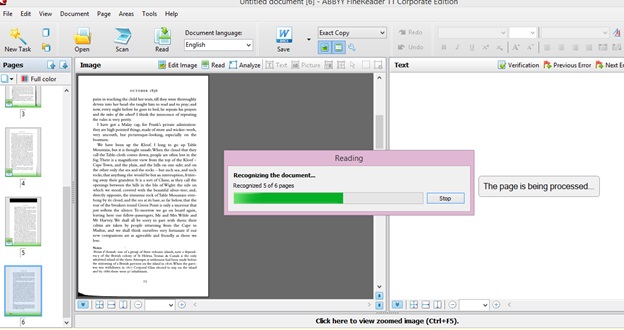
If you want to build a letter corpus from a printed correspondence you can easily transfer a book into .txt files. This can be done by scanning the letters, saving them as image files, and running an OCR on the images. The OCR software will turn the images into machine-readable text. Often the software only allows you to save the text in a PDF or Word file, after which you can save it as a .txt file. Mind that even though this is a wonderful tool, it is not free of errors; always reread your texts to make sure they are exact copies of the original!OCR programme

There are several OCR programmes on the market. I prefer to use ABBYY FineReader, a very user-friendly programme; unfortunately, not an open source programme. I looked up some alternative free OCR programmes for this post. If you don’t want to download software then Online OCR is a good alternative. I tested this one and the text was an exact copy. Cuneiform (scroll down and click English version set-up link if you want to download and install Cuneiform) and Simple OCR are simple and user-friendly programmes (the latter is not extremely accurate but you can easily spot the mistakes as these are marked in the document). A very accurate free OCR programme is Tesseract. This programme has been on my laptop for a month and I haven’t used it because I haven’t been able to find a good guide to set up this programme properly. You might want to give this one a try if you’re tech-savvy.

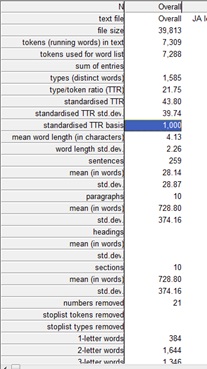
WordSmith statistics If you want to analyse letters by means of a corpus linguistics approach concordancing programmes are indispensable. My favourite programmes are WordSmith Tools and Antconc. WordSmith is a programme with many great features. The basic features concord, keywords, and the wordlist are pretty straightforward and don’t need a lot of clarification. The statistics tab in the wordlist menu is a lifesaver for me as I am not the biggest fan of calculating things myself. The menu bar holds another interesting feature, namely ConcGram. This features finds clusters of words that often occur together in your corpus. It is not a simple feature – as you will have to build some things yourself – but worth the effort if you are interested in word clusters. An example of word clusters can be seen in the picture below.

WordsmithAntconc is a free concordancing programme (can be downloaded here). It is maybe a bit less straightforward in its use compared to WordSmith Tools. But Laurence Anthony has very detailed tutorials on youtube on how to work with this programme. I recommend to watch the tutorials before you want to start with this programme!

blog5This programme has the same basic features as WordSmith. The keyword list looks a bit different than the one in WordSmith. Antconc shows the words that are key in your corpus and not the negative keywords. However, if you tick the show negative keywords box in the settings this will all be resolved. Antconc also has a feature to show which clusters are salient in your corpus, named N-grams (see print screen below). You don’t have to do anything yourself to make this feature work.

The one let-down of Antconc is that you’ll have to do the statistics yourself. The only numbers Antconc will provide you with are the number of types and tokens. I highly recommend this concordancing programme as it is free and you can work from your own computer.

If you have any other tips and tricks on how you go about your study in Late Modern English letters please comment in the comments section.


Posted in Uncategorized | Tagged , , , | 1 Comment

ESL in the Late Modern Netherlands

Queen Wilhelmina (1880-1962) (Wikipedia)

Today we are visiting the Dutch Royal Family Archives in The Hague, to be able to study the English letters the former Dutch queen Wilhelmina wrote to her governess Miss Saxton Winter. An edition of the letters was published in 2012, by Emerentia van Heuven-van Nes, but unfortunately they were translated into Dutch. So now we will have the opportunity of seeing the letters in the original. One of the questions we will consider is how good Wilhelmina’s English was, and perhaps also whether her English improved over the years. These questions are part of a larger ongoing research project on English as a second language (ESL) in the Netherlands, during the Late Modern period.

The project: During the eighteenth century, there was considerable interest in the Netherlands in English literature and other writings in that language, but actually learning English was not easy. English was not as yet a subject that was taught in schools, nor were textbooks such as grammars and dictionaries easily available for learners. Most problematic of all was the general lack of native-speaking English teachers (Tieken-Boon van Ostade 2012). Yet various people managed to acquire the language and become quite skillful in writing in English. One of them was the Frisian clergyman Johannes Stinstra (1708-1790) who had translated Samuel Richardson’s novel Clarissa into Dutch. Another was the Leiden Arabist H.J.A. Schultens (1749-1793), who (unusually for a foreigner) managed to obtain an MA degree from the University of Oxford. And Belle van Zuylen (1740-1805) was yet another learner of English, whose skill in the language as far as I can tell was quite considerable.

In an ongoing project studying the performance of Late Modern Dutch ESL speakers (or rather writers), we have so far studied the language of two such speakers, Stinstra and Schultens (Verschuure 2012; Kastelein 2014), and an analysis of Belle van Zuylen’s English is in progress. Focussing on letters by Late Modern Dutch ESL learners, we are compiling a corpus of English as a second language in the Netherlands, and to this end we are looking for more material by eighteenth and nineteenth-century Dutch letter writers, men and women from, if at all possible, different social classes. Research on the letters will be done in the context of research done on code switching in a wider European context (Sairio 2014). For further information, please contact us!:

References:

Kastelein, Emma (2014). I shall find you quite an Englishman? Hendrik Albert Schultens 1749–1793 and the learning of English as a second language. Research Master thesis, University of Leiden.

Sario, Anni (2014). Code-switching in Late Modern L2 English: the Autobiography of Joseph Emin (1726-1809). Paper presented at the conference Historical Code-Switching: The Next Step, University of Tampere, 11-13 June 2014.

Tieken-Boon van Ostade, Ingrid (2012). Late Modern English in a Dutch context. English Language & Linguistics 10/2, 301-317.

Verschuure (2012) ‘We therefor did not the draft’. The importance of English and English language teaching and learning in the Netherlands in the eighteenth and nineteenth centuries. A case study. Master thesis University of Leiden (for a summary, see https://latemodernenglishletters.com/2012/09/19/late-modern-dutchmen-writing-english/).

Posted in 18th-century letters, 19th-century letters | Tagged , , , | Leave a comment

“That we are Your Servants wherever we go”

All the MA students in this year’s MA course on Late Modern English Letters have to write blog posts on their findings. Here is the first one, and it is by Sabine Krouwels:

A couple of weeks ago, we discussed the subject of opening and closing formulas in the MA Linguistics course The Sociolinguistics of Late Modern English Letters. We learned that there are set rules for such formulas and that writers barely deviated from those rules.

Wikipedia

However, while conducting a pilot study for my research essay on the language in the correspondence of poet and dramatist John Gay (1685-1732), I came across a very free adaptation of opening and closing formulas in the following letter, written in Canterbury on Saturday 17 July 1717:

My Dear Belladine
O’re a Glass of Wine
We send you this line
On Purpose to tell
You & Miss Lepell
We are all very well
If news we should send you from Canterbury
That news to be sure you would think is a lye
And therefore we’ll say what before you did know
That we are Your Servants wherever we go.
Ann Pulteney
Wm. Pulteney.
J Gay.

This letter is written by John Gay and Ann and politician William Pulteney to Mary Bellenden, Maid of Honour to Caroline, Princess of Wales, or Belladine. It was written in Pulteney’s hand, though probably dictated by Gay. (The letter can be found in C.F. Burgess’s edition of Gay’s letters published in 1966.)

One instantly notices that this letter is written as a short, colloquial sounding poem. The second line “O’re a Glass of Wine” sets the scene: John, Ann and William are enjoying a glass of wine on a warm summer evening and decide to send word to their mutual friend Mary Bellenden and Mary Lepell, another Maid of Honour. This gives the letter/poem its light and amicable tone.

Let’s have a look at the opening and closing formulas. The opening formula is actually formulated as was expected in these days: “My Dear Belladine” shows no uniqueness as far as the formula goes. It is worth noting, though, that Mary is addressed by her nickname Belladine. There are two reasons I can think of why they would have used her nickname: they either knew her very well and therefore named her Belladine all the time; or, it was for the sake of the rhyme with the next sentence. However, a quick Google-search confirms that Mary Bellenden was called Belladine by friends (Crocker 1824), so a combination of these reasons seems very likely.

Looking at the closing formula, we can see that the style is very different from what we are used to from those days. To me, it seems a poetic version of the standard formula ‘I am/ Your Humble Servant’, since the last sentence says “we are Your Servants”. The last part of that sentence, “wherever we go”, might be a reference to the fact that the trio was traveling to the Continent at the moment this letter was written.

All in all, the closing formula sounds very amicable to me. These four or five people must have known each other quite well for them to deviate from the norms so strongly when writing each other. Either that, or they were just horribly drunk …

I have not been able to find more instances of such free interpretation of opening and, especially, closing formulas yet, however, perhaps someone has found similar instances in other letters?

References:

Crocker, John Wilson, ed. Letters to and from Henrietta, Countess of Suffolk, and Her Second Husband, the Hon. George Berkeley: From 1712 to 1767. Vol. 1. London: John Murray, 1824.

Gay, John. The Letters of John Gay. Ed. C.F. Burgess. Oxford: The Clarendon Press, 1966.

Posted in 18th-century letters, letter writing | Tagged , | Leave a comment

Sennight a dialect word?

This week, in the MA course on Late Modern English letters I teach, we read an article by Frances Austin about how William Clift (1775-1849) quickly lost any traces of his original dialect when he moved from his native Bodmin in Cornwall to London in 1793. One of the dialectal features Austin discusses is his use of the construction yesterday was (a) week, and she gives the following example:

  • the footman left us last monday was Sennight (6 April 1792)

Sennight (or Senight) is an interesting word, being a contraction from seven night(s), meaning “week”, and it has been in the English language since at least the thirteenth century, according to the Oxford English Dictionary. It is no longer very frequent today, and the OED notes for the eighteenth century that the word is dialectal.

Source: Wikipedia

In my own research I have come across the word in the language of Robert Lowth (1710-1787) and also in that of Jane Austen (1775-1817):

  • I propose being in Town abt. nex[t] Wednesday Sennight (Robert Lowth, 2 January 1769)
  • Our fate with Mrs L. & Miss E.  is fixed for this day senight (Jane Austen, 5-8 March 1814)
  • they leave home tomorrow senight (Jane Austen 21 April 1816)

Both writers were born in Hampshire, and sen(n)ight may indeed already have been dialectal during the second half of the eighteenth century.

Source: Wikipedia

I have recently become interested in the language of Belle van Zuylen (1740-1805), an aristocratic  Dutch writer of French literature, who had acquired English as well. To study the question of how good Belle van Zuylen’s English was, I have been graciously given access to a project led by Suzan van Dijk which aims at digitising her entire correspondence. And in searching the material for any evidence of English, I found the following reference to sennight:

  • Il y a quinze jours est parfaitement analogue à il y a huit jours, et je suis étonnée que les Hollandais disant veertien dagen, ne disent pas aussi seven dagen geleden. En anglais on dit Fourt nigt ago qui est la contraction de Fourteen nigts (quatorze nuits) mais on dit this day sennigt contraction de seven nigts (ce jour (il y a) sept nuits). Toutes les langues ont leur bizarreries auxquelles il faut se soumettre (Belle van Zuylen, July 1794).

“Bizar”, she calls the word! It is not entirely clear how or where Belle van Zuylen had learnt English, but it is clear from this quotation that she was quite familiar with the language. The quotation does suggest that sennight was perhaps more common at the time than being just a feature that was current in the Hampshire dialect. I’d be interested to have more instances of the word, to see what its exact status was at the time, so please let me have them if you know of any.

Reference:

Austin, Frances (1994), The effect of exposure to standard English: The language of William Clift. In: Dieter Stein and Ingrid Tieken-Boon van Ostade (eds.), Towards a Standard English 1600-1800. Berlin/New York: Mouton de Gruyter. 285-313.

Posted in 18th-century letters, 19th-century letters | Tagged , , , , , , , | 4 Comments