An MA course on Late Modern English letters

The coming semester, I will be teaching another MA course on Late Modern English letters. The aim of the course is for students at Leiden to learn all about letter writing during that period, including analysing the language of this very interesting and important text type. Students will be expected to write blog posts on their findings as well, so readers of this blog will be receiving regular bits and pieces of state-of-the-art information on LModE letters. I hope you will be looking forward to this as much as I am.

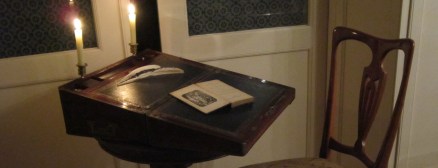
As a foretaste, here is an image of a letter writing desk from my own collection, very similar to the one owned by Jane Austen, held by the British Library. The picture was recently posted (with permission of course) on a Korean website on the eighteenth-century room. Fascinating – though unfortunately I can’t read Korean, but perhaps other readers of this blog can.
Posted in 18th-century letters, 19th-century letters, news | Leave a comment

The next Late Modern English Conference

… will take place in Ragusa, Sicily, from 7-9 May 2020, organised by Massimo Sturiale. Great news for all of us who are doing research on Late Modern English letters.

This will be the seventh conference in a row. Earlier ones were held in Edinburgh in 2000 (I believe), in Vigo in 2004, in Leiden in 2007, in Sheffield in 2010, in Bergamo in 2013, and in Uppsala this year (2017).

Thanks to Carol Percy for this very useful link called HEL on the Web.

Conference proceedings:

LModE Conference 1: Dossena, Marina, and Charles Jones (eds.). 2003. Insights into Late Modern English. Bern: Peter Lang.

LModE Conference 2: Pérez-Guerra, Javier, Dolores González-Álvarez, Jorge L. Bueno-Alonso & Esperanza Rama-Martínez‘. 2007. ‘Of varying language and opposing creed’: New insights into Late Modern English. Bern, etc.: Peter Lang.

LModE Conference 3: Ingrid Tieken-Boon van Ostade and Wim van der Wurff (eds.) (2009), Current Issues in Late Modern English. Bern etc.: Peter Lang.

LModE Conference 4: 2012: special issue of English language and Linguistics (16).

LModE Conference 5: Dossena, Marina (ed.). 2015. Transatlantic Perspectives on Late Modern English. Amsterdam/Philadelphia: John Benjamins Publishing Company.

Posted in news | Tagged | Leave a comment

Jane Austen’s Language …

… is the topic of this year’s Sample Lecture for English organised by the Leiden University Humanities Faculty on 15 April 2016. During this lecture you will learn why Jane Austen’s language (in addition to her novels) is of interest in its own right, and why the language of her letters is particularly important when we want to learn more about Jane Austen as a person.

The lecture will be followed by a seminar in which we will look at things like the form of Jane Austen’s letters, and in which we will use a digital tool to analyse the language of the letters and the novels. If you are interested: register for the lecture plus seminar here. And if you do decide to come to Leiden for this event: don’t forget to bring a pair of scissors!

Posted in letter writing, news | Tagged | Leave a comment

Happy birthday, Jane Austen!

Yesterday, if she had lived that long, Jane Austen would have turned 240. Imagine all the novels she would have been able to write! Not to mention letters …

Birthdays, it appeared, were important events in her life, as an analysis of her letters shows. Read all about it on OUP’s blog.

Posted in news | Tagged | Leave a comment

The Mary Hamilton Papers available online

Letters carefully transliterated from the Mary Hamilton Papers in the John Rylands Library are freely available to any interested reader. The corpus currently stands at 161 letters dated 1764-1819 – over 70,000 words of text. The Image to Text project website displays each letter with mouse-over notes and clarifications alongside a high-quality image of the original letter, plus metadata. The site works best with Chrome or Firefox.

Mary Hamilton Papers
The content will be of interest to historians, students of Late Modern English letter-writing, and historical linguists.

For offline research, including corpus searches or systematic use of metadata, we are happy to supply a zip archive of fully compliant TEI/XML files plus a zip of plain text versions, a frequency list of word forms in the corpus and a table of word counts per letter. The corpus is for non-commercial use, is free, and is being added to each year. Please see the website for a short online registration form.


Contact David Denison and Nuria Yáñez-Bouza for further information.


Posted in 18th-century letters, 19th-century letters, letter writing, news | Tagged , | Leave a comment

A treasure trove indeed

Not Late Modern and not English either – still, a real find, this treasure trove of undelivered Dutch letters from the 17th sentury, 2600 of them.

From what I heard on the radio yesterday, the letters will remained unopened. They will be read though, with the help of new X-ray techniques. What will they be about, and what will we be able to learn about the language of the period? Exciting news indeed.

Thanks to Carol Percy for the link.

Posted in news | Leave a comment

Jane Austen and James Stanier Clarke

If you are interested in what this satirical print has to do with Jane Austen – read the following article, which has just come out:

Tieken-Boon van Ostade, Ingrid (2015), Jane Austen’s correspondence with James Stanier Clarke, in Anglistentag 2014 Hannover, Proceedings, ed. by Rainer Emig and Jana Gohrisch. Trier: Wissenschaftlicher Verlag. 79-90.

Small hint: you will find the image in the Wikipedia entry on James Stanier Clarke. The key question is: would Jane Austen have known about its existence?

Posted in news | Tagged , , | Leave a comment

Belle van Zuylen’s letters

The Belle van Zuylen Correspondence project is looking for volunteers to transcribe the letters (most of which are in French). Look at their blog (in Dutch) for more information.

Posted in 18th-century letters, news | Tagged , | Leave a comment

Periphrastic do and Colonial Lag

And since she sent me both blogposts all at once, here is Esther Spaanderman’s second one, also on the Adams Papers: “But as I speak french very imperfectly and she understands not a syllable of English I suppose she did … Continue reading

More Galleries | Tagged , , , , | Leave a comment

Dont vs. don’t: early American usage?

Esther Spaanderman is the last of my students who owes us her blogposts. Here is the first one:

John Adams (Wikipedia)

A while ago, I studied periphrastic do in the letters of John Adams (1735-1826), the second president of the United States. As I was interested in colonial lag, I compared a selection of Adams’ letters to letters by a British contemporary, Horace Walpole (1717-1797). Walpole has already been the subject of other posts in this blog.

Walpole (Wikipedia)

One of the linguistic differences I observed in the writings of Walpole and Adams concerns the spelling of the contraction of do not. Adams consistently used a contracted form, whereas Walpole rarely did so. The sample of the Adams correspondence I analysed contained eighteen instances of a contraction of do not, but spelled as dont. In Walpole’s correspondence I found only two instances of the contraction, spelled don’t. According to the OED, the form without the apostrophe has been in use since the 1700s, though from the 1800s onwards it came to be was regarded as non-standard. As for don’t, the OED indicated that this form, which is now the standard, has been in use since 1600.

I noticed in the OED entry on do is that the quotations with dont mostly appear in American sources. One quotation from 1670, for example, is from the Rhode Island Historical Society Collections, and another from the Journal and letters, 1767–1774 by the American Philip Vickers Fithian. This made me wonder whether dont might be somehow associated with early American English. So far, I have been unable to find any evidence for this assumption, but perhaps readers of this blog can help me here. So please let me know if you have ever come across dont (without the apostrophe) in Early or Late Modern English texts. Would it indeed  be possible that dont is more common in American texts? Please leave a comment.

Posted in 18th-century letters | Tagged , , , | Leave a comment