Grammars, cookbooks and letter-writing manuals

What do Late Modern English grammars, cookbooks and letter-writing manuals have in common? They all show a remarkable increase in popularity during the 2nd half of the 18th century. I’ve described this for grammar books in Tieken-Boon van Ostade (2008), and this is particularly evident for the publication history of Robert Lowth’s grammar of 1762, but we see a similar increase in the popularity of Hannah Glasse‘s The Art of Cookery Made Plain and Easy (London 1747), which was reprinted at least 33 times within fifty years of its original publication (Tieken-Boon van Ostade 2009:139).

The reason for the popularity of these two books is similar: the effects of the Industrial Revolutions were already beginning to make themselves felt. People with more money wanted explicit guidance of correct language use and on how to entertain in style. But what about letter-writing manuals?

These, according to Fens-de Zeeuw (2008), became very popular, too: of The Compleat Letter-Writer, Fens-de Zeeuw notes, “at least nineteen editions [were published] until 1800”, after it first came out in 1756. The need for guidance was the same: the 18th century has become known as the great age of letter-writing, and in particular women needed instructions on how to write letters, but so did the lower classes. It is particularly for their further education that these letter-writing manuals contained brief grammars and presented spelling and punctuation rules, alongside of course providing practical rules on how to address members from the different sections in society.

There are differences as well: while Hannah Glasse’s cookery book was published by subscription, Lowth’s grammar was not, nor were the letter writing manuals. At least, the ones in ECCO do not contain lists with subscribers, unlike the copies of Hannah Glasse’s book. These lists, by the way, offer is a fascinating insight into who her readers were: mostly women, and mostly from the (lower?) middle classes.

References:

Fens-de Zeeuw, Lyda (2008). ‘The Letter-Writing Manual in the Eighteenth and Nineteenth Centuries: From Polite to Practical’, in Marina Dossena and Ingrid Tieken-Boon van Ostade (eds.), Studies in Late Modern English Correspondence: Methodology and Data, Bern: Peter Lang. 163-92.

Tieken-Boon van Ostade, Ingrid (2008). ‘The 1760s: Grammars, Grammarians and the Booksellers’, in Grammars, Grammarians and Grammar Writing in Eighteenth-Century England, Berlin/New York: Mouton de Gruyter, 101–124.

Tieken-Boon van Ostade, Ingrid (2009). An Introduction to Late Modern English. Edinburgh: Edinburgh University Press.

Posted in Uncategorized | 1 Comment

Dr Bell’s system

Reading the post on Julia Maitland’s letters, one of our readers, Tony Fairman, was struck by the reference to “Dr Bell his sytem”. He kindly sent us his notes on Dr Bell, for others to read. The notes relate to the work Tony has been doing on Higher-class schooling of the Lower Classes: England 1800-70.

1797. Andrew Bell, An Experiment in Education, made at the Male Asylum of Madras. London.

Preface. v. In the education of youth three objects presented themselves to my mind: to prevent the waste of time in school; to render the condition of pupils pleasant to themselves; and to lead the attention to proper pursuits. In other words, my purpose was to make good scholars, good men, and good Christians.

p. 11. … writing the letters with the finger in sand … [p. 13] The same manner of writing on the sand is practised with the double letters and words of two letters. In like manner the digits and numbers are taught. Then the scholar proceeds as usual till he begins dissyllables, when he is never allowed to pronounce two syllables till he has gone through the child’s first and second books, and a spelling book. The advantage is manifest; for the moment you allow the scholar, he will put the syllables together and pronounce the word at once; to which, indeed, every learner is of himself disposed. The only difficulty is, to teach them to read syllables by themselves, and words by [p. 14] themselves, and not a whole sentence at once, as many boys, who have come to this school after some progress, do. And in this case they make continual blunders, not only in the beginning and middle, and especially in the terminations of words; but also constantly mistaking one word for another, leaving out and introducing words at random. It is on this account that the scholar is not allowed, for some time after he reads a word at once, to join two words together, as in the usual mode of speaking and reading, but is directed to pause awhile [sic] at the end of every word; and whenever he mistakes any word he must read it by syllables, as thus, “com-men-da-ble.”

1844. Robert Southey, Vol. I. The Life of the Rev. Andrew Bell, D.D. LL.D. F.As.S.  F.R.S.ED. Prebendary of Westminster, and Master of Sherburn Hospital, Durham, Comprising the History of the Rise and Progress of the System of Mutual Education. John Murray, London. Vols II and III by his son the Rev. Charles Cuthbert Southey. B.A.

Vol. I. p. 171. the teachers [in the school in Madras] themselves had every thing to learn relating to the management of a school. They were men who had never been trained in tuition, but were taken from very different occupations […] [p. 172] He [Bell] found also, that whenever he had succeeded in qualifying a man for performing his business as an usher in the school he had qualified him for situations in which a much higher salary might be obtained with far less pains. […] [p. 173] […] happening on one of his morning rides to pass by a Malabar school, he observed the children seated on the ground, and writing with their fingers in sand […]  the usher at last declared it was impossible to teach boys in that way […] [p. 174] He bethought himself of employing a boy, on which obedience, disposition, and cleverness he could rely, and giving him charge of the alphabet class. The lad’s name was John Frisken; he was the son of a private soldier, had learned his letters in the Asylum, and was then about eight years old.  […] What the usher had pronounced to be impossible, this lad succeeded in effecting without any difficulty. […] Accordingly, he appointed boys as assistant teachers to some of the lower classes, giving, however, to Frisken the charge of superintending both the assistants and their classes, [p. 176] As to any purposes of instruction, the master and ushers were now virtually superseded. They attended the school so as to maintain the observance of the rules […] Their duty was not to teach, but to look after the various departments of the institution […]  The master’s principal business regarded now the economy of the institution […]

Vol. I. p. 185. No less than forty-six boys, in the lower classes, receive their elementary letters from a youth trained in the school himself, who learned his letters there, and who is not yet twelve years of age ….

1980. Denis G. Paz, The Politics of Working-class Education in Britain, 1830-50.  Manchester UP.

p. 4. the Anglican Andrew Bell and the Quaker Joseph Lancaster developed independently a method that promised cheap and efficient instruction for large bodies of pupils. Their method, monitorialism, was a system of instruction wherein the master taught each lesson to a group of able students (monitors) who in turn taught the rest of the children.

SUMMARY

Joseph Lancaster’s British and Foreign School Society was founded in 1808. Rev. Andrew Bell’s National Society (also known as The Madras System) was founded in 1811. Both were charity movements and aimed to teach reading, and mechanical writing to children of the poor, lower classes, aged about 7-12. Both also aimed to teach the children their ‘station in life’ through the Bible. Bell was Church of England and Lancaster Quaker. Apart from that religious difference, their teaching methods and content were identical. Neither taught children to compose or use writing for self-expression, but only to form the letters in the conventional ways, and to practise their lettering by copying from the Bible and other religious literature. Schools of both societies were started all over England by the middle and higher classes for the lower classes.

Many thanks for sharing your ntoes with us, Tony.

Tony Fairman is coming to Leiden to give a guest lecture on his work on minimally-schooled letter writers on 7 November 2012.
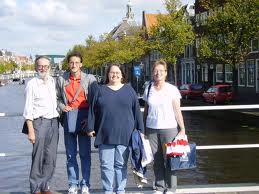
 

Tony Fairman (left) on a previous visit to Leiden (2007).

Posted in Uncategorized | 1 Comment

Late Modern Dutchmen writing English

For his MA thesis in Linguistics at the University of Leiden, Marijn Verschuure analysed two corpora of letters written in English by Dutch people. The first corpus consisted of 83 short commercial letters that were presumably written by the directors of the Dutch publishing house De Erven F. Bohn. These letters date from the period 1873-1920. The second corpus, which he used as a reference corpus, consisted of six letters from the Dutch clergyman Johannes Stinstra (1708-1790) addressed to the English writer Samuel Richardson (1689-1761), whose novel Clarissa had been translated into Dutch by Stinstra. The aim of this study was to examine if these two corpora were representative ofthe position of the English language and English language teaching in the Netherlands at the time when the letters were written.

To achieve this aim, Marijn chose to analyse native language interference errors in both corpora, with special attention to word order errors, which occur in quite large numbers in the letters written by Stinstra. He compiled a list of several word order errors, ranging from adverbials placed in the wrong position to SOV word order being used in subclauses, which is appropriate in Dutch but not in English. This list of errors was compiled on the basis of Swan & Smith’s Learner English. A teacher’s guide to interference and other problems (2001). Besides, he tried to comparethe number of errors found in both corpora, and thus the letter-writers’ proficiency in English, to the way in which they had acquired the English language, and to the position of English and English language teaching in the Netherlands in the eighteenth and nineteenth centuries.

In the Bohn letters, he found only fifteen errors of the types that were included in my analysis, against as many as 104 errors in Stinstra’s letters. Besides, he found some differences between the two corpora in the types of errors made. Stinstra, for example, frequently used Dutch SOV word order in subclauses, an error that the writers of the Bohn letters did not make at all.

These differences in the errors made by the writers of both corpora can at least partially be attributed to different ways of learning English. The writers of the Bohn letters were taught English in school, and they had access to lots of English language textbooks, including commercial correspondence manuals. Moreover, one of the presumed writers of the Bohn letters spent a few years as a trainee at the London publishing house Fisher Unwin, which no doubt contributed to his proficiency in English. Stinstra, on the other hand, was entirely self-taught in English, because in the eighteenth century, English was not taught in Dutch schools and universities.

Marijn’s conclusion on the basis of his analysis was that, indeed, the English writing performance of Stinstra and the writers of the Bohn letters can be seen as characteristic of the role that the English language and ELT played in the Netherlands in the eighteenth and nineteenth centuries.

Many thanks for this summary, Marijn, and congratulations on completing your MA Linguistics at Leiden!

Posted in Uncategorized | Leave a comment

text crossing

Last night I came across a nice example of text crossing on someone’s blog. I haven’t seen one like this before, and it appealed to me immediately. I think it’s fascinating to see how letters could be written, in a certain pattern.


Posted in Uncategorized | 2 Comments

Dodsley’s portrait

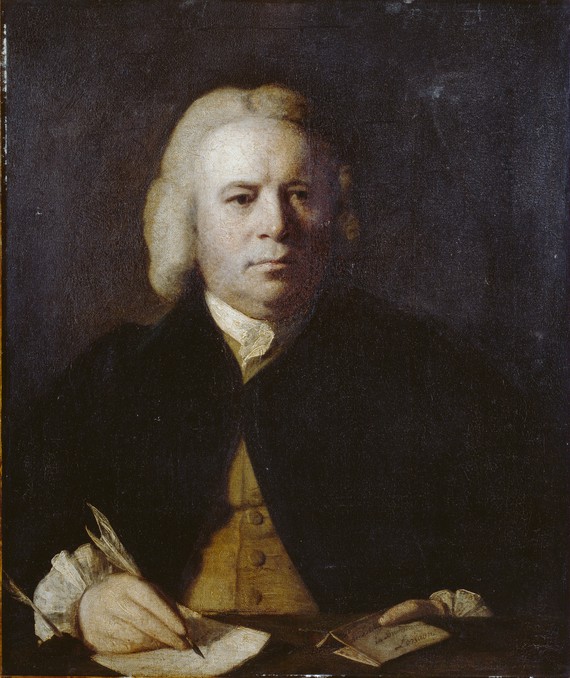
There is a lovely portrait of Robert Dodsley (1704-1764), one of the most important bookseller/publishers from the period, and who was also a writer. Dodsley was the instigator of Dr Johnson’s Dictionary (1755), and he also published Robert Lowth‘s Short Introduction to English Grammar (1762).

What I think is most striking about the portrait is that he let himself be painted as a letter writer, even in the very act of letter writing: there is a bottle of ink in the left corner, and there is a finished letter (a letter he recieved?) under his left hand. This must be significant, particularly in the light of Susan Whyman’s study of middle and lower-middle class letter writers (for her book The Pen and the People, see elsewhere in this blog). Dodsley started his career as a footman, and we know next to nothing about his education. But he did become one of the most important publishers of the age, and letter-writing must have played an important role in this.

Dodsley kept a file of the letters he exchanged with his authors, including Robert Lowth, with whom he developed  close friendship. The letters were published in 1988. They give a fascinating insight into the history of eighteenth-century publishing.

Reference:

Tierney, James E. (1988). The Correspondence of Robert Dodsley 17331764. Cambridge etc.: Cambridge University Press.

Posted in letter writing | Tagged , , | Leave a comment

OED not (yet) helpful on Turkies

Analysing Jane Austen’s spelling in her letters, I found the plural Turkies rather than Turkeys as we spell it today:

he hopes all your Turkies & Ducks & Chicken & Guinea Fowls are very well (letter 21)

We are just beginning to be engaged in another Christmas Duty, & next to eating Turkies, a very pleasant one, laying out Edward’s money for the Poor (letter 77).

The spelling Turkeys does not appear in the letters. I wanted to know how common this spelling was at the time, and consulted the OED Online. There we find under “Forms”:
“Also 15–16 turkie, 15–17 turky. Pl. turkeys, formerly turkies. .” But what does “formerly” mean, and when did the old practice end? Going through the quotations I found that the plural turkies did not occur beyond the 17th century.

My next step was ECCO, and a keyword search produced 1686 results, throughout the 18th century. My favourite source from the year 1800 is The farmer’s boy; a rural poem, in four books, by Robert Bloomfield (1766-1823), an “English labouring class poet“:

For pigs, and ducks, and turkies, throng the door, /And sitting hens, for constant war prepar’d (p. 12).

The spelling in this quotation should most probably be attributed to the publisher (the printer or typesetter) of the book, rather than to Bloomfield himself.

The entry for Turkey, as Fiona McPherson explains in her comment to this post, has not yet been revised, and more precise information on the spelling history of the word will eventually be provided based on the available evidence. As for Jane Austen’s usage, I am now able to conclude that it was, to begin with, no spelling error, as she used the same spelling twice. (I found in my study of her language that she is actually quite a good speller, though an idiosyncratic one.) And more importantly, the plural Turkies was still quite common at the time.

Posted in 19th-century letters | Tagged , , , | 1 Comment

Jane Austen’s letters

In October last year, a new edition was published of Jane Austen’s letters (OUP, 2011). It is the fourth edition, and the editor is Deirdre Le Faye, a well-known Austen specialist. The previous edition, also by her, dates from 1995 – which is not mentioned in the book’s bibliographical details following the title-page, I wonder why. Since 1995, no new letters by or to Jane Austen have come out, so why this new edition?

Apart from the fact that there is – or, as Jane Austen would have put it, apart from there being a new preface and the omission of Chapman’s Introduction to the first edition (1932), the one really wonderful addition to the edition is the “Letters Subject Index”. This index is a useful research tool, as I already discovered when writing an article on the language of Jane Austen’s Will: I was curious to find out if Jane Austen would ever have been in a position of reading Wills, as the language of her own Will is so appropriately formulaic that she must have been familiar with the legal register. Under the entry “Deaths, funerals, memorials” in Le Faye’s index I found a long list of names. Not all of the people mentioned would have been in a position of drawing up a Will, such as “Ann (maidservant)” or “Beach (child)”, but others were, and there are several references in the letters to Wills and legacies.

Jane Austen’s Will, peculiarly enough, is included in the edition of the letters, as item 158. It is not a letter, nor is it folded like one, as the copy from the National Archives clearly shows. (The Will can be obtained from the National Archives at a small fee, as can Wills of other famous people.)

The letters of the third edition have been digitised as part of the series Intelex Past Masters. It is good to know that despite the new edition of the letters this is still a valuable resource for digitally analysing the letters.

Reference:

Tieken-Boon van Ostade, Ingrid (about to be submitted), “To my dearest Sister Cassandra”:  An analysis of Jane Austen’s Will.

Posted in news | Tagged , , | Leave a comment

Letters from India

Julia Maitland’s letters, reported one earlier in this blog, are part of a larger tradition of women publishing their correspondence from the time they spent in India. We have two more such editions at home:

  • Emily Eden, Up the Country: Letters from India, originally published in 1866 [reissued with an introduction by Virago Press in 1983].
  • Eliza Fay, Original Letters from India, ed. by E.M. Forster, first published in 1817 in India and later edited Forster for The Hogarth Press in 1925 [reissued in 1986 by Chatto and Windus]

Emily Eden (1797-1869) is described in the preliminaries to the book as “a prominent political hostess”, who accompanied her brother George Eden to India when he became Governor-General there. Apart from the published letters recording her stay in India (1835-1842), she published two novels in 1859 and 1860. The entry in wikipedia mentions Jane Austen as being her favourite author.

Eliza Fay (1755/56-1816) went to India (Madras and Calcutta) in 1779 with her husband who was a lawyer. The blurb of the modern edition of the book  refers to her “hilarious gusto, unusual sympathy and telling eye” as characterising her writing.  Eliza is described as “a seamstress, teacher and luckless merchant”. She died in Calcutta, and the letters were published in India a year after her death. I have been unable to find a picture of her.

I haven’t checked the text, but expect that we have to be careful is attributing all that we find in the language in these books to the writers themselves. There may have been any amount of editing of the text. Normally I believe that reliable scholarly editions can be taken to appear only after 1935 (Tieken-Boon van Ostade 2005), but for all that, the letters may contain similar interesting material as those by Julia Maitland.

If you are going to read the letters for their linguistic interest, please report your findings to us here.

Reference:

Tieken-Boon van Ostade, Ingrid (2005). “Eighteenth-century English letters: In search of the vernacular”. Linguistica e Filologia 21. 113-146.

Posted in Uncategorized | Leave a comment

Addison’s hand

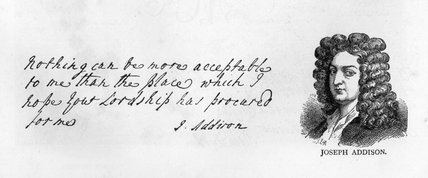
One of my students was writing a paper on Joseph Addison’s Will, and because she wanted to verify if the Will was actually in his own hand, she googled for “Joseph Addison” and “handwriting”. Joseph Addison lived from 1672 to 1719, and he is described in Wikipedia as an “English essayist, poet and playwright”. The udent found an image of a letter, watermarked “Photographers Direct.com”. The letter is dated 4 September 1714, and it is held in the British Museum. The web page notes that this image is not free to be used, and that a minimum fee of £50 is charged for using it in print. For the student’s purpose, it was good enough, and she was able to verify that the Will was indeed in Addison’s own hand.

Checking her procedure, I too googled for “Joseph Addison” and “handwriting”, and came across a website that sells images of famous authors with a specimen of their handwriting.

What wonderful things you can buy on the Internet! Would they have such an offer for Jane Austen as well, I wondered, and searched Google with the string “handwriting signature Jane Austen”. The fifth hit was a website that analyses people’s handwriting, and sure enough Jane Austen’s too! Read the analysis for yourself if you’re interested: does it fit what we know about her character?

Posted in 18th-century letters, 19th-century letters | Tagged , , | 1 Comment

The Browning letters again

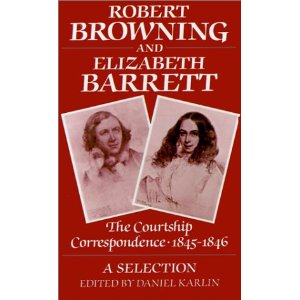
Another Browning specialist informed me that, as far as he knew, the Baylor letters project is “free to air”: excellent news. He also recommended the book The Courtship of Robert Browning and Elizabeth Barrett by Daniel Karlin (1985, Oxford: Clarendon Press) .  It draws on the letters, but it isn’t a linguistic study – which would therefore seem a welcome and potentially very interesting addition to current Browning scholarship.

Daniel Karlin also publised an edition of selected courtship letters (1989, Oxford: Clarendon Press). Both books are available in the Leiden University Library.

You will find more information on the Browning letters project here. You can also subscribe to a regular update of the collection.

Thanks for your information, John!

Posted in 19th-century letters | Tagged , | Leave a comment