Bilingual letter-writers

Recently, I stumbled upon a family photo album. While browsing through it, I found several letters from the early twentieth and late nineteenth century, all written in Dutch. Despite this, I noticed that the use of language, even the use of formulas, is quite similar to that found in some English letters from the same period. For this reason, I think it might be possible that some Dutch letter-writers were influenced by English ones or that there was a universal guide to letter-writing at the time. I also found that there were bilingual letter-writing manuals available in the early twentieth century. This suggests that bilingual letter-writers did exist and more surprisingly, it shows that epistolary formulas and words had equivalents in other languages. Furthermore: for these guides to be published, there must have been quite a few potential buyers. Despite this, I have not yet managed to find any bilingual letter-writers. As I would like to do some more research on the subject, I have some questions:

  • Does anyone know of any bilingual letter-writers who lived during the eighteenth, nineteenth, or early twentieth century?
  • Were there published any bilingual letter-writing manuals in England in the aforementioned period?
  • Was there a universal guide to letter-writing?

I hope someone will be able to answer these questions. Thank you in advance.

Posted in letter writing | Tagged , , | 2 Comments

The Clift Family Correspondence

While I was searching for an interesting topic for my paper, I came across a book named Letter Writing as a Social Practice. I am interested in the Clift family letters and I explicitly want to focus on William Clift’s written interaction (and language variation) with his eldest sister Elizabeth and his other siblings. Frances Austen has also written an article for this book named Letter Writing in a Cornish Community in the 1790s. She starts her article by providing some revelant background information about William Clift’s childhood and eventually shifts the attention to the written correspondence among William Clift and his siblings. According to Austen, “the Clifts possessed rather more than merely ‘functional literacy’, if by that is meant writing merely to ascertain the health and welfare of family members and to assure them that they were not forgotten” (2000, p. 58). In addition, this book also contains articles on topics such as pauper letters, children’s letters and letter-writing in America.

References:

Austen, Frances (2000). “Letter Writing in a Cornish Community in the 1790s”. In: David Barton & Nigel Hall (eds.) Letter Writing as a Social Practice. Amsterdam: John Benjamins. 43-61.

Posted in 18th-century letters, 19th-century letters, letter writing | Leave a comment

Aristocrats

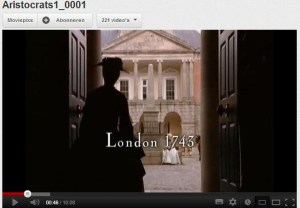
When skimming through Aristocrats by Stella Tillyard 1994, I came upon the name of Madame de Sévigné whose letters were quoted and used as models by English women of noble birth (page 88). The male writers used Latin in their correspondence, showing off their classical education while the female writers used French to show that they too had a form of education. It is a pity that my French is not up to standard to be able to read Madame de Sévigné’s letters because they seem(ed) highly captivating, especially the ones she wrote to her daughter, Madame de Grignan. In those letters, she gave her opinion about everyday life and commented on the act and art of letter writing.

Aristocrats is a very interesting read about the Lennox sisters, the four children of the Duke of Richmond: Caroline, Emily, Louisa, and Sarah, who wrote to each other nearly every day in the 18th century. This book needs more attention than just skimming and it will be my next holiday read. In the meantime, I watch the 1999 Television series in short episodes on YouTube whenever I have a break.

Posted in 18th-century letters | 1 Comment

The Penny Black Stamp

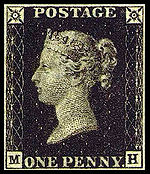
When reading the ‘Browning Love Letters” I noticed that a “Penny Black” postage stamp was adhered to its envelope. The Penny Black was the first stick on -postage stamp ever used. I knew of its existence, but not when it was first introduced. Browsing the internet, I came upon a website from the British Postal museum and Archive. We know that before the introduction of a stamp, postal duty was paid by the recipient and was based on the distance the letter had to be carried and on the amount of letters it contained. Sir Rowland Hill came up with the idea of a it use a pre-paid system in 1837. With this system, the person sending the letter had to pay the duty (the amount of which was based on its weight) rather than the addressee. The Penny Black came into actual use in 1840.

Source: http://www.postalheritage.org.uk/page/pennyblack

Posted in 19th-century letters, letter writing | 1 Comment

The varying degree of formality in John Wesley’s letters

This gallery contains 10 photos.

In the course Letters as Sociohistorical-Linguistic Documents, we have learned that social status was of great importance in the late modern English society. Therefore, it comes as no surprise that especially experienced writers applied a variety of different styles to … Continue reading

More Galleries | Tagged , , , , | 1 Comment

Swift’s correspondence letters.

Whenever I contemplate about writing and letters, the word ‘poet’ always comes to mind.

Even though poets have their way of swinging and knocking about with words, making them seem like art, poets were in my opinion the most obvious people who indoubtedly had a range of words to choose from in their lexicon when writing a letter. It is interesting to see how these words were chosen and wether they were being used subconciously or not.

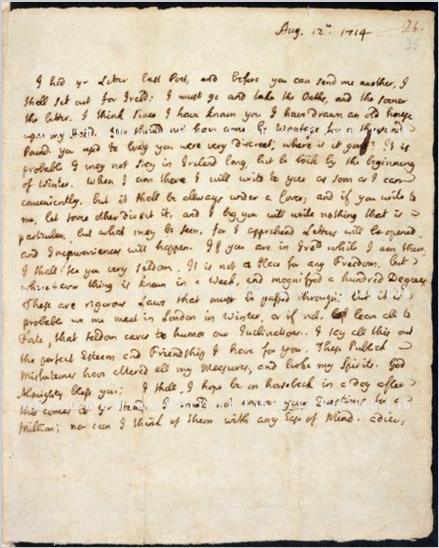
Having said this, Jonathan Swift had popped up in my search for a poet with a need for correspondence (as far as one can assume that it was necessary to him). I found a letter of correspondence between him and a woman named ‘Vanessa’. The letter looks like Swift is declaring his love to her, but seems to be too far away to be with her. It is quite interesting to see how he uses his words, knowing him as the writer of books and poetry.

Posted in Uncategorized | Tagged | 3 Comments

Collection of John Wesley’s Letters

This gallery contains 6 photos.

We have seen the edition of Wesley’s letters from 1721-1755 which Frank Baker put together; we have heard of the online collection of 138 letters that the Bridwell Library put on their website; but – until today – I did not … Continue reading

More Galleries | Tagged , , , | 1 Comment

Pauper letters

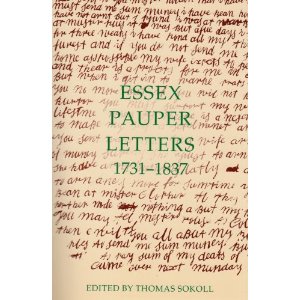
Anyone interested in pauper letters will come across Thomas Sokoll’s book Essex Pauper Letters, 1731-1837, published in 2001. An online review of the book came out in HistoricalSociolinguistics/Sociohistorical Linguistics two years later.

But the book is also cited as important introductory reading on the topic “Letters to Parish Officials seeking Poor Relief”, on a website called London Lives 1690-1800 – Crime, Poverty and Social Policy in the Metropolis. The webpage reproduces an instance of such a letter, showing that the writer’s “letteracy”, as Tony Fairman calls it in an article on the subject, cannot have been very high. The letter has been transcribed on the website, and can be enlarged to make for detailed analysis.

Reference:

Fairman, Tony (2008). “Strike-throughs: What textual alterations can tell us about writers and their scripts, 1795-1835”. In: Marina Dossena and Ingrid Tieken-Boon van Ostade (eds.), Studies in Late Modern English Correspondence. Bern etc.: Peter Lang. 193-212.

Posted in 18th-century letters, 19th-century letters | Tagged , , | Leave a comment

The Greatest Love Story Ever Told…

This gallery contains 2 photos.

I am not talking about Romeo and Juliet, Lancelot and Guinevere or Paris and Helena. These two are not as widely known, but their story “is surely one of the most fascinating love-stories in the world” (Kenmare 1957:7). This is … Continue reading

More Galleries | Tagged , , , | 1 Comment

Correspondence Deserving of a Wider Audience

Image from the Open Knowledge Foundation Blog: http://blog.okfn.org

During the last few weeks of the course Letters as Sociohistorical-Linguistic Documents, I’ve been reminded of the many special linguistic insights which letters are able to provide. We’ve read,* for example, about how letters may provide evidence for reconstructing social relationships and social networks. Here’s a neat video from Stanford University’s Republic of Letters project about tracking an 18th-century social network through letters.

Letters are great because they are able to provide linguistic insights at level of idiolect as well as dialect. For example, the cross-outs and other self-corrections found in letters may provide information about, among other things, the writer’s personal usage habits and the usage conventions of the period in which the letters were written. (This lovely essay on letters refers to cross-outs as ‘electrocardiograms of the soul.’)

Handwriting is another rich source of information for linguists. The handwriting of a letter may provide clues about the education level, occupation, and social status of the writer. Moreover, a careful, controlled script or a hasty scrawl may indicate the emotional state or the immediate circumstances under which a letter was written. Another important advantage of studying personal letters is that they are a source of language which is, in principle, not affected by the observer’s paradox.

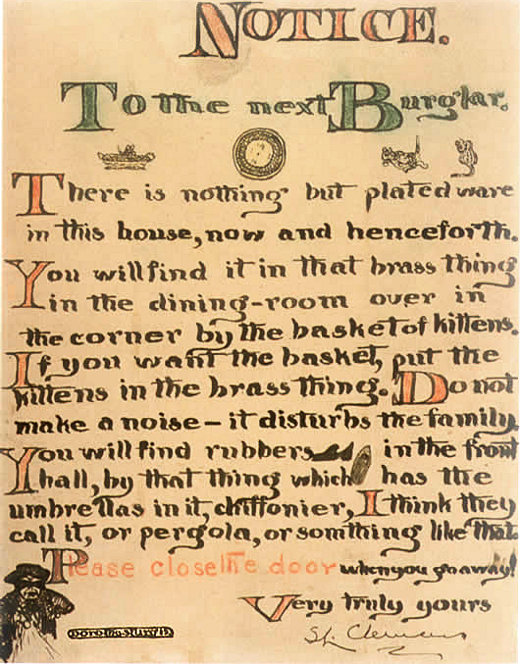
Samuel Clemens’ ‘Notice to the Next Burglar,’ Image from http://www.lettersofnote.com/2012/01/to-next-burglar.html

I recently had a serendipitous encounter with the fantastic website: Letters of Note: Correspondence Deserving of a Wider Audience. I wholeheartedly agree with the site’s subtitle. Letters of Note currently contains the texts of 804 letters from 112 AD to the present. The site provides various options for browsing – or you can try your luck by clicking on the right-hand link for ‘random letter.’ I found the handwritten letters (which are accompanied by transcriptions) particularly interesting in light of their potential as a source of linguistic information – in addition to their aesthetic and emotional resonance. In any event, I think the material found on the Letters of Note site is valuable to linguists and aficionados of letters and beautiful things alike.

*In Dossena, Marina and Tieken-Boon van Ostade (eds.). 2008. Studies in Late Modern English Correspondence: Methodology and Data. Bern: Peter Lang.

Posted in 18th-century letters, 19th-century letters, letter writing | Tagged , , , , , , , , | Leave a comment