Joseph Banks in a Dutch Track Shoot

About a year ago, I gave a workshop to our second-year students here at Leiden on eighteenth-century letter writing. To practice their newly acquired skills, the students had to produce a transcription of a letter by Sir Joseph Banks (1743-1820), whose letters are available online through the website of the State Library of New South Wales. I promised that the best transcription would be published in this blog, and it was.

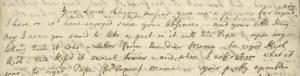
But there was a runner up, the transcription of a letter by Banks to his sister Sophia Banks, by Natasja Kosten and Kyra Macfarlane. The reason for this was that the students had taken the assignment to transcribe the text as closely as possible very literally, reconstructing the way the original letter had been folded:

The address panel

Opening the letter

One of the reasons I personally like this letter is that there is a reference to Banks travelling from The Hague (“a most beautiful town”) to Amsterdam by “Track Shoot”. Originally, Natasja and Kyra had been unable to identify the word, and no wonder, but that is what it is, an idiosyncratic rendering of the Dutch word trekschuit, defined by the Oxford English Dictionary as “A canal- or river-boat drawn by horses, carrying passengers and goods, as in common use in Holland; a track-boat” (s.v. trekschuit, treckschuit). The earliest quotation dates from 1696, and here we have another one for the eighteenth century. Banks’s spelling is not in the OED though.

Here is the transcription of the letter by Natasja and Kyra: Sir Joseph Banks to Sarah Sophia Banks.

Posted in 18th-century letters | Tagged , , | Leave a comment

From Letters to Legislature

Do you love 18th/19th century letters and/or documents? Do you love to transcribe?

If you answered Yes, then the Transcribe Bentham Initiative might be just up your alley!

Transcribe Bentham is an initiative started by University College London, with the mission to make available the transcripts of Jeremy Bentham, 1748-1832, (and relations) that UCL has in its possession. The initiative is managed by UCL’s Bentham Project and Digital Humanities, and aided by the Computer Centre of UCL.

The transcriptions are made by volunteers, such as Iris (co-writer to this post and fellow Linguistics student at Leiden University) and myself, and checked by editors who check whether they agree with the transcription and re-read it for spelling errors and whether you used the right codes, as there are special codes such as “<lb/>” as enter and “&amp;” for an &.

The transcriptions themselves range from letters to the family, to official documentation relating to the use of pieces of land, to definitions of legal terms. Furthermore, not all transcripts are in English, but also in Latin, Greek and French (so in case you can read/speak/write those languages, give transcription a try and help further the progress of full transcriptions, which is at 32,01% at present).

An example of a transcription is 537/011/001, a letter by Jeremiah Bentham, relating some information about Jeremy Bentham as a toddler:

“Your sweet obliging Answer gave me a pleasure far beyond any
I have or cod have enjoyed since your Absence — and your little Jerry —
Boy I asure you seem’d to take a part in it with his Papa upon my
telling him it was a Letter from his dear Mama — he cryed Kish,
Kish — and Kiss’d it several times and when I ask’d him what it
was — he cryed Pape (for Paper) Mama”

That was the start of a young boy who would eventually become a great philosopher, jurist and the founder of utilitarianism. Furthermore, the ideas of equal opportunity promoted by Jeremy Bentham contributed to UCL’s policies and made it available that University College London was open to students of all races, classes, or religions and, most importantly for the women at that time, gender!

Here a fun anecdote about Jeremy’s obliviousness, age 12, already at Queen’s College, Oxford, 537/043/001:

“but Oh my Stupidity, I put it
into my pocket with a design to send it, but as it was not then
time I went about something else and forgot to send it. ’till
this morning when putting my hand in my pocket for something
else, I pulled out the letter designed for you: I believe
I was never much more vexed than I was then”

As you can see, even child prodigies can be forgetful! There is hope for us all yet!

P.S. In case you want to join Team Bentham and start transcribing, click here!

References:

Information on Jeremy Bentham: http://blogs.ucl.ac.uk/transcribe-bentham/jeremy-bentham/
Information on Transcribe Bentham: http://www.transcribe-bentham.da.ulcc.ac.uk/td/Transcribe_Bentham
Letter by Jeremiah Bentham: http://www.transcribe-bentham.da.ulcc.ac.uk/td/JB/537/011/001
Letter by Jeremy Bentham: http://www.transcribe-bentham.da.ulcc.ac.uk/td/JB/537/043/001


Posted in 18th-century letters, 19th-century letters | Tagged , , , , , , | 1 Comment

Jane Austen and the art of letter writing

Jane-Austen-Writing-DeskIs this a new image of Jane Austen? Would she have owned a writing desk like the one in the picture? And how would she have acquired the art of letter writing? Read all about it on OUPblog.

Posted in letter writing, news | Tagged | Leave a comment

Officially out today

Though the book was published several weeks ago already, the true publication date, so its actual birthday, is today, 20 February 2014. For a description of the book’s contents, look at OUP’s website, and feel free to get in touch if you want to learn more about it!

Cover of the book

The book received a mention at the website of the Dutch Jane Austen society, Jane Austen.nl.

Posted in 18th-century letters, 19th-century letters, news | Tagged , | Leave a comment

Carriers of Closeness: the letters of Charlotte Brontë

…I am determined to write, for I should be sorry to appear a neglectful correspondent to one from whose communications I have derived, and still derive, so much pleasure (Smith 1995: II, 128).

Wikipedia

Charlotte Brontë (1816–1855) wrote these words to her friend and publisher William Smith Williams on 18 October 1848. Charlotte Brontë is probably best known for her novel Jane Eyre, which was published in 1847 under the pseudonym Currer Bell. However, in her relatively short life she wrote several other novels as well as many letters to her publishers and her friends, many of which remain and can be read today.

For her BA thesis Annemarie Walop, a student at the University of Leiden, decided to try to assess the closeness of the relationship between Charlotte and her correspondents by looking at the opening formulas she used and at the level of linguistic involvement in her letters (Walop 2013). Her corpus consisted of 394 letters, written by Charlotte from 1848 to 1851.

On the basis of the methodology developed by Tieken (2009), Annemarie established a hierarchy of opening formulas for Charlotte Brontë’s letters, ranging from the most formal to the most informal formulas. Annemarie found that Charlotte used as many as nine different opening formulas, ranging from the formal Madam to the informal Dear Nell. She used different formulas for the same people as well, especially with new correspondents. She would use the most formal opening formula in her first letter, and in subsequent letters a less formal one. This was the result of a visit that had occurred in between the writing of the first and the subsequent letters. Annemarie also found that Charlotte varied in her use of Dear and My dear. Apparently, she did not use the forms with and without the possessive pronoun to differentiate between lesser and stronger degrees of formality.

Charlotte Brontë used the least formal forms of address in letters to her father and her closest friends Ellen Nussey and Mary Taylor, and she used the most formal forms of address to her business relations and to a lady of the nobility. The use of informal opening formulas corresponded to a higher level of closeness, whereas the use of formal ones agreed with a lesser closeness between Charlotte and her correspondents.

Annemarie also calculated Charlotte’s linguistic involvement with her correspondents in order to assess the strength of her relationship with them. She used the same linguistic features as Sairio (2005), which were the occurrence of the first person singular pronoun (ego-involvement), of the second person singular pronoun (interpersonal involvement), and of degree adverbs and evidential verbs (involvement with the subject matter). After adding up all the different frequencies, Annemarie found that Charlotte was most involved with some literary critics, and she was least involved with her father and one of her lifelong friends.

These results were unexpected, so Annemarie came up with a few possible explanations for the results. It might have been the case that Charlotte’s relationship with her father was not as close as is assumed, or that Charlotte’s nineteenth-century letters are different from the eighteenth-centuries letters that have been previously investigated by means of linguistic involvement. Or maybe Charlotte Brontë’s letters are simply the odd ones out?

(Summary of the thesis by Annemarie Walop.)

References:

Sairio, Anni (2005). “‘Sam of Streatham Park’, a Linguistic study of Dr. Johnson’s membership in the Thrale family”. European Journal of English Studies, 9.1:21-35.

Smith, Margaret (1995). The Letters of Charlotte Brontë. 3 Volumes. Oxford: Clarendon Press.

Tieken-Boon van Ostade, Ingrid (2009). An Introduction to Late Modern English. Edinburgh: Edinburgh UP.

Walop, Annemarie (2013). “Carriers of closeness in correspondence: Opening formulas and linguistic involvement in Charlotte Brontë’s letters”. BA thesis, University of Leiden

Posted in 19th-century letters | Tagged , | Leave a comment

Just out

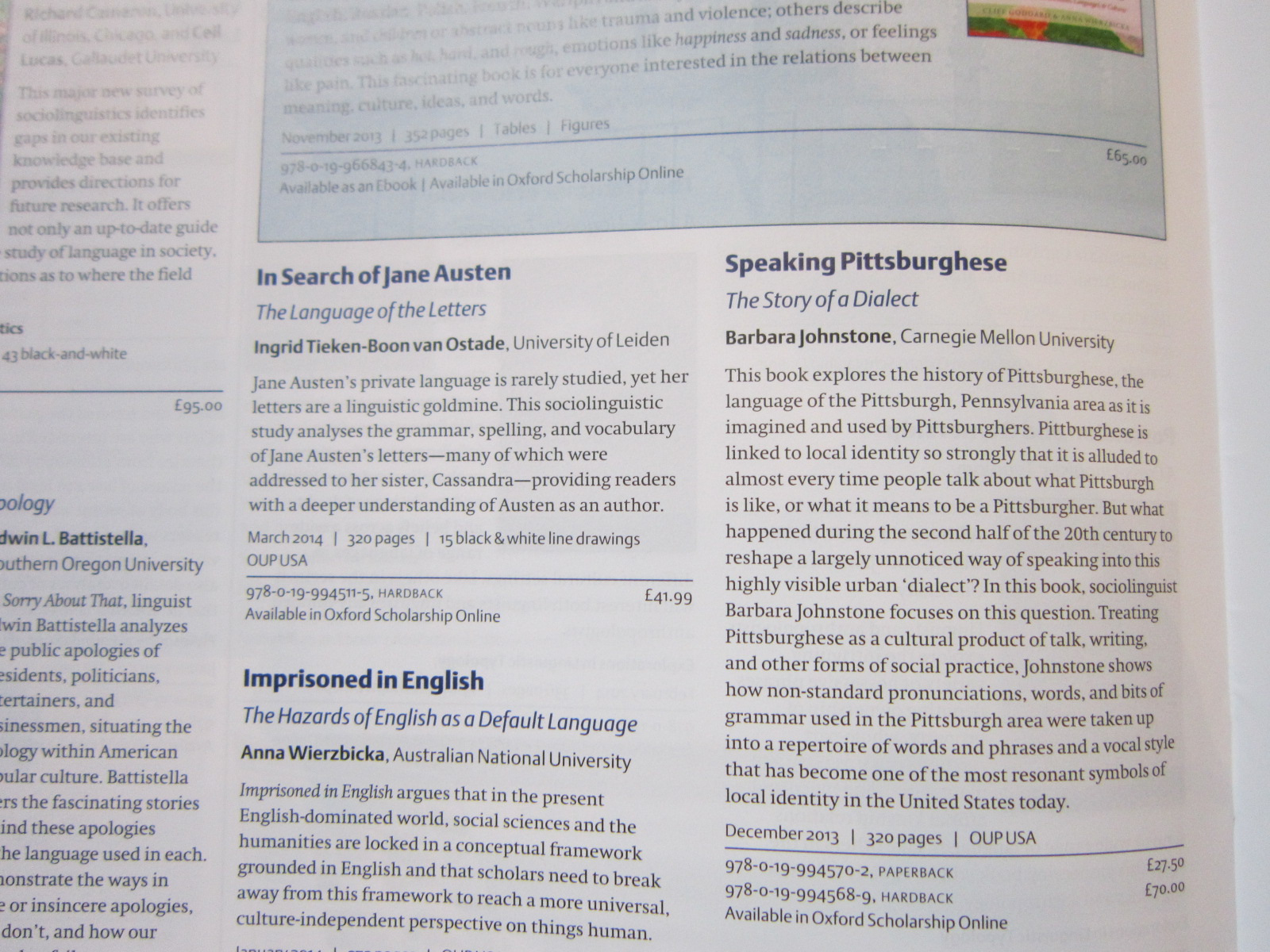
Earlier this week, my book In Search of Jane Austen: The Language of the Letters (OUP) was published. This is how it is described in the OUP linguistics catalogue that came in today:

OUP Linguistics catalogue

OUP Linguistics catalogue

And here is the missing image:

Image of the cover

Posted in 18th-century letters, 19th-century letters, news | Tagged , , | Leave a comment

Letters to Sir Joseph Banks

Sir Joseph Banks (Wikipedia)

This year, in our course Philology 3 (History of the English Language), the students did a project on the correspondence of Sir Joseph Banks (1743-1820). Banks is described on Wikipedia as a “naturalist, botanist and patron of the natural sciences” (he has of course an entry in the ODNB, too). His letters and other papers are available online through the website of the State Library of New South Wales, though in facsimile only (which is fantastic as it is, as it gives us access to the original letters). The assignment was for the students to transcribe a letter as closely as possible, and to comment on the form and style used.

Valerie Brentjes transcribed a letter from a certain J.T. Bell (Series 24.03, CY 3008 200-201) addressed to Banks on the subject of a woman called Mary Rose, who was convicted to being transported to Australia for a period of seven years for the crime of “stealing clothing from a house”.

Transcription by Valerie Brentjes

Transcription by Valerie Brentjes

2 pounds and 11 shillings “for Bed & necessaries which are to be the property of the Convict when landed”: to find out how much this would have been in Mary Rose’s time, the money can be converted with the help of the Currency Converter on the website of the British National Archives. It comes down to nearly £143 in today’s money, not a great deal to start a new life on. Mary Rose seems to have gained Bell’s sympathy, for he writes that he will try to raise some money for her from his friends.

Despite her conviction and the long journey ahead of her. Mary Rose didn’t do so badly after her arrival on Norfolk Island in 1791. She died in August or September 1832, at the age of 63, and she was buried in the churchyard of St Philips.

Mary Rose in Australia

The extract from the record on the website Convict Stockade, “a Wiki site for Australian Convict Researchers”, shows that she had married a certain John Trace in 1790, so before her arrival, and that she remarried after John died. After the term of her transportation had ended, she didn’t return to England. She died in August or September 1832, at the age of 63, and she was buried in the churchyard of St Philips in Sydney.

The letter is formal, as can be concluded from the opening and closing formulas: “Sir”, it starts, not “Dear Sir”, and it ends similarly: “I remain Sir Your most obedient humble Servant”. It is, after all, a matter of business that the writer informs Banks of, though, to his credit, not without feeling.

Posted in 18th-century letters | Tagged , | Leave a comment

The spelling of a president’s daughter

Inge Otto, research master student at the University of Leiden, wrote her BA thesis this summer on the letters of Abigail Adams, the daughter of one of the presidents of the United States. What follows is a summary of her findings:
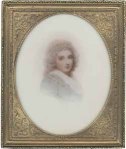
Abigail Adams“Abigail Adams was born in Braintree, Massachusetts in July 1765. She was the eldest child of Abigail Smith (1744-1818), who belonged to a leading family in Braintree, and an ambitious lawyer called John Adams (1735-1826). Thirty years after Abigail’s birth, in 1797, the ambitions and hard work of her father made him the 2nd President of the United States.

During Abigail’s childhood, both her father and two of her brothers were more often away than at home in Braintree: the former for his travels and commitments abroad and the latter for their studies (in Auteuille, France and in Leiden, the Netherlands). To keep in touch with her father, her brothers John Quincy and Charles, and with other relatives, friends, and aquaintances, Abigail and her mother wrote letters.
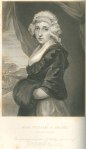
Abigail Adams (2)A number of Abigail’s letters have come down to us, and they have been collected in the Adams Papers (books) but they are also available on the web (the Massachusetts Historical Society created an online database). For my bachelor thesis I decided to look into Abigail’s letters, and I came across numerous spellings that struck me as odd: chaimber, oald, attemted and Colledge were some of them. Abigail had been taught how to write letters (her father probably had her copy letters for him) and – unusual for girls in the eighteenth century – her parents had sent her to school in Boston for a while. How could these spelling variants be explained?

Unlike today, spelling in the eighteenth century was not fixed yet. In the Late Modern English period printers started to print books according to rules of the so-called printers’ spelling, but people did not necessarily adhere to these rules when writing private letters – not at all. There existed what Osselton (1984) called a “dual spelling system”.

The examples listed above happen to be phonetic spellings I found in letters Abigail wrote to people she had a very close relationship with: her brother John Quincy and her cousin Elizabeth Cranch. The way Abigail spelled these three words reflects the way she pronounced them. The fact that she wrote chaimber rather than chamber, suggests that she pronounced it as /tʃeɪmbə(r)/. In the case of oald, Abigail probably tried to spell the word like other words with the same sound, for instance Coachman – which she used in a letter to JQA in 1785 ­– for this word would be pronounced as /ˈkoʊtʃmən/.

Spelling variants like chaimber, oald, attemted, and Colledge occurred in informal letters Abigail wrote to her brother and cousin. However, formal letters which Abigail had sent to people that were neither relatives or friends of her did not show any of these phonetic spellings. What I concluded in my thesis, then, was that variation in Abigail’s spelling seemed to correlate with the relative formality of her letters.

Isn’t it amaizingly interesting what some 18th-century letters can tell you?”

References

Anon. The Adams Papers: Digital Collections. Massachusetts: Massachusetts Historical Society.

Butterfield, L.H., ed. (1963a), The Adams Papers Volume 1: December 1761-May        1776. Cambridge: The Belknap Press of Harvard UP.

Butterfield, L.H., ed. (1963b), The Adams Papers Volume 2: June 1776-March 1778. Cambridge: The Belknap Press of Harvard UP.

Gelles, Edith B. (1992), Portia: The World of Abigail Adams. Bloomington: Indiana       University Press.

Osselton, N. E. (1984), “Informal Spelling Systems in Early Modern English: 1500-        1800”, in Rydén, Tieken-Boon van Ostade and Kytö (eds), 33-45.

Posted in 18th-century letters, spelling | Tagged , , | Leave a comment

Learning to read an 18th-century hand

Eighteenth-century handwriting may seem hard to read at first sight, yet you do get used to it once you get going. And in the course of reading a person’s handwritten texts, you develop a feel for the writer’s particular characteristics.

If you wish to develop this skill to be able to read letters from the period, good advice may be found on the website Martha Ballard’s Diary Online. Martha Ballard (1735-1812) was a New England midwife, who kept a record of the babies she dilivered for 27 years.

Martha Ballard’s Diary Online

You can practise transcribing the diary by clicking on Try Transcribing, and after checking your transcription, you will be able to get more guidance from the dohistory toolkit.

Posted in Uncategorized | Tagged , , | Leave a comment

Ever yours?

Jane Austen (wikipedia)

The first letter by Jane Austen that has come down to us, addressed to her sister Cassandra, ends as follows:

I condole with Miss M. on her losses and with Eliza on her gains, and am ever yours,/J. A. (letter 1, ed. Le Faye 2011:3).

Cassandra Austen (wikipedia)

In the correspondence, it is very unusual, even in the letters to Cassandra, which are the most intimate ones in the collection: there is only one other instance besides this one, in letter 61. I have never come across this formula in 18th-century letters before, though reading Annemiek Korf’s MA thesis on John Wesley‘s letters to his wife, I discovered that Wesley used the form too, though only once.

So how common was this form in Late Modern English? Do we only find it in love letters, like Wesley’s, or is it also common in letters between correspondents who were extremely close, such as Jane Austen and her sister Cassandra?

Reference:

Le Faye, Deirdre (2011), Jane Austen’s Letters [4th ed.]. Oxford: Oxford University Press.

Annemiek Korf is one of the contributors to this blog.

Posted in 18th-century letters | Tagged , , | Leave a comment