Penholder’s Everybody’s Letter Writer

This gallery contains 3 photos.

Today I received a surprise package in my mail! Of course, I remembered ordering a copy of Penholder’s Everybody’s Letter Writer: being a Complete Guide to Letter Writing, but the website (abebooks.com) had told me that it would take 10 to … Continue reading

More Galleries | Tagged , , , , | Leave a comment

Not yet transcribed letters

While searching the internet for not yet transcribed letters, I found a link to an interesting website called Letter Archive Project.

This site shows transcribed and not yet transcribed letters from the 18th, 19th and early 20th centuries. The letters contain themes of love and romance, religion, family, friends, legal and business matters.

Image

Posted in Uncategorized | 1 Comment

Children’s letters

As I am interested in why children wrote letters  between the 17th and 19th century, apart from the fact that it was considered something children should be taught among the higher classes, does anybody have an idea of where to look for collections? I am thinking about writing an essay on this topic, so I would certainly appreciate any information available.

Posted in Uncategorized | 1 Comment

Warburton’s language

There are 13 letters in the Leiden University Library by William Warburton (1698–1779), who is described by the ONDB as ‘bishop of Gloucester and religious controversialist’. One of the people he entered into a controversy with was Robert Lowth (1710-1787).

For a brief overview of the letters in Leiden, see Tieken-Boon van Ostade (2012), but the reason for mentioning them here is that their language at times is unusually strong. They include the following:

  1. this infamous work, the display of Arminianism (20 March 1758)
  2. Owen’s wicked book (28 July 1758)
  3. But the manner of criticising according to this new interpretation is as preposterous, as the matter is absurd (24 June 1759)
  4. the Booksellers have taken the advantage of it, & have enriched themselves by this national Madness (11 December 1765)
  5. The uncharitable book you speak of, written written by an immiserable Calvinist Minister . . . to soften their horrid doctrine of damnation (28 August 1769)
  6. the Leaders of this ridiculous Sect amongst us, called Methodists, are either very weak Fanatics or covert knaves (4 December 1766).

This is not how you would expect someone to write to a colleague, let alone someone who was not very skilled at English to begin with! I wonder, though, where this tendency to use strong language came from. Was it perhaps due to some kind of congenital disorder with Warburton? Is it what made him get into trouble with people like Lowth, for instance?

Warburton’s letters have never been published, but it seems to me that it would be well worth doing so. They seem to make very good material for studying this particular phenomenon in an 18th-century letter writer. But we first need to know more about what may have caused Warburton’s language use. Any medical information on this, please?

Reference:

Tieken-Boon van Ostade, Ingrid (2012). “Late Modern English in a Dutch context”, English Language and Linguistics, 16/2, 301-317.

Posted in 18th-century letters, letter writing | Tagged , | Leave a comment

Examples in letter-writing manuals: real or fiction?

After our group discussion of last Tuesday, I became interested to know whether or not the exemplary letters in the discussed letter-writing manuals such as The Complete Letter Writer were real or not. Even though my primary impression was that these exemplary letters might be considered as genuine letters, further investigation has indicated that these exemplary letters show very little similarities to authentic historical letters of the same time. Susan Whyman states in her book named The Pen and The People: English Letter Writers 1660-1800, that “one way to approach this problem is to compare the models suggested for use in manuals with actual letters. In truth, few letters were found in family archives that resembled those in published guides. Nor were there references to using manuals in real letters, though examples sometimes appear in personal book lists” (2009, p. 28). Although the exemplary letters of letter-writing manuals provide us with a primary realistic image, it can be concluded from the lack of factual and historical data that these letters are not authentic historical documents written during real correspondences, instead they can be considered as fictional products of various authors.

References
Whyman, Susan (2009). The Pen and the People: English Letter Writers, 1660-1800. Oxford: Oxford University Press.

Posted in letter writing | Tagged | Leave a comment

Empire of Letters

This gallery contains 1 photo.

I just came across this (old) reference in my mailbox (with thanks to Richard Dury for telling me about the book a long time ago): EVE TAVOR BANNET, Empire of Letters: Letter Manuals and Transatlantic Correspondence, 1688-1820. Pp.xxiii + 347. … Continue reading

More Galleries | Tagged | Leave a comment

Possession by A.S. Byatt

A highly interesting novel to read is ‘Possession’. It typically fits into this blog for it is about a correspondence between two writers in the 19th century. Moreover, the main characters researching the works of these writers are two academics. This book is written in such a realistic way that it certainly seems like the writers are genuine ones. This is accomplished through stating  (made up) sources and also in the way the characters analyse the letters.

Furthermore, Byatt has created many letters and passages of works the writers would supposedly have written. This adds to this genuine feeling. Here is a link to a site with additional information.

Posted in Uncategorized | Leave a comment

Penholder’s identity

Upon reading the article The Letter-Writing Manual in the Eighteenth and Nineteenth Centuries: From Polite to Practical by Lyda Fens-de Zeeuw, a number of interesting research questions came to mind. For me the most challenging and thought provoking question was the following:

Would it be possible to reconstruct the identity of Penholder? How much information can we deduce in terms of gender, age, socioeconomic status, etc?

In order to research this particular question I would need a substantial database of letters written in the same period of time as Penholder. These letters should be written by men and women of all sorts of backgrounds and from a large range of different age categories. This database should not be too difficult to construct.

My problem lies in the following: Penholder’s manual titled Saxon’s Everybody’s Letter Writer, being a Complete Guide to Letter Writing (1896), is nowhere to be found. Does anyone have more information about this book? Does anyone know where I could possibly find it?


Reference:

Fens-de Zeeuw, Lyda 2008. The Letter-Writing Manual in the Eighteenth and Nineteenth Centuries: From Polite to Practical. In Dossena, Marina / Tieken-Boon van Ostade, Ingrid (eds) Studies in Late Modern English Correspondence: Methodology and Data. Bern etc.: Peter Lang, 163-192.

Posted in 19th-century letters, letter writing | Tagged , , | 2 Comments

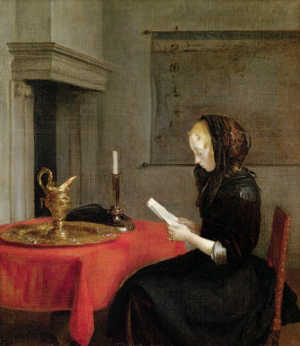
The Letter in Dutch Genre Paintings

Having learned that in the 18th and 19th century, people of high status liked to have themselves depicted writing a letter, I started wondering to what extent letter-writing was a central theme in the arts. In Dutch Genre Paintings in the Age of Vermeer (Sutton et al. 2003) I read that – in the Netherlands – the earliest paintings showing figures writing, reading, or handling letters date from the 1630s (Sutton et al. 2003:15). An example for this is a painting by Gerard ter Borch. From the 17th century onwards, the letter became a very popular theme in Dutch genre painting. This also reflects the Dutch culture: The Netherlands were a maritime nation and literacy was a valuable skill for sailors and people living far away from home. Only by writing letters they could keep in touch with their family and friends (Sutton et al. 2003:26). There are numerous paintings from Vermeer and other painters making use of the letter-theme. I think that the popularity of the letter-theme in 17th-19th century paintings is really fascinating, since it says a lot about the importance of letter writing as a cultural practice in those days.

Reference:

Sutton, Peter, Lisa Vergara, and Ann Jensen Adams. 2003. Love Letters:Dutch Genre Paintings in the Age of Vermeer. London: Frances Lincoln Ltd.

Posted in Uncategorized | Leave a comment

Transcription of Elizabeth Carter’s Letter

This gallery contains 2 photos.

Despite all the proposals my transcription has prompted, I have incorporated most of them by consensus. That is the reason why three words are still displayed in brackets since such expressions require further analysis. Therefore, I would be glad of … Continue reading

More Galleries | Tagged | 3 Comments